
Godot pathfinding / 2026-07-12 / 14 min read
Verified as of Godot 4.7 stable
Rectangular and Circular Agent Clearance in Godot
Handle rectangular and circular agents on Godot grids with footprint masks, summed-area tables, radius fields, and explicit rotation rules.
The direct answer
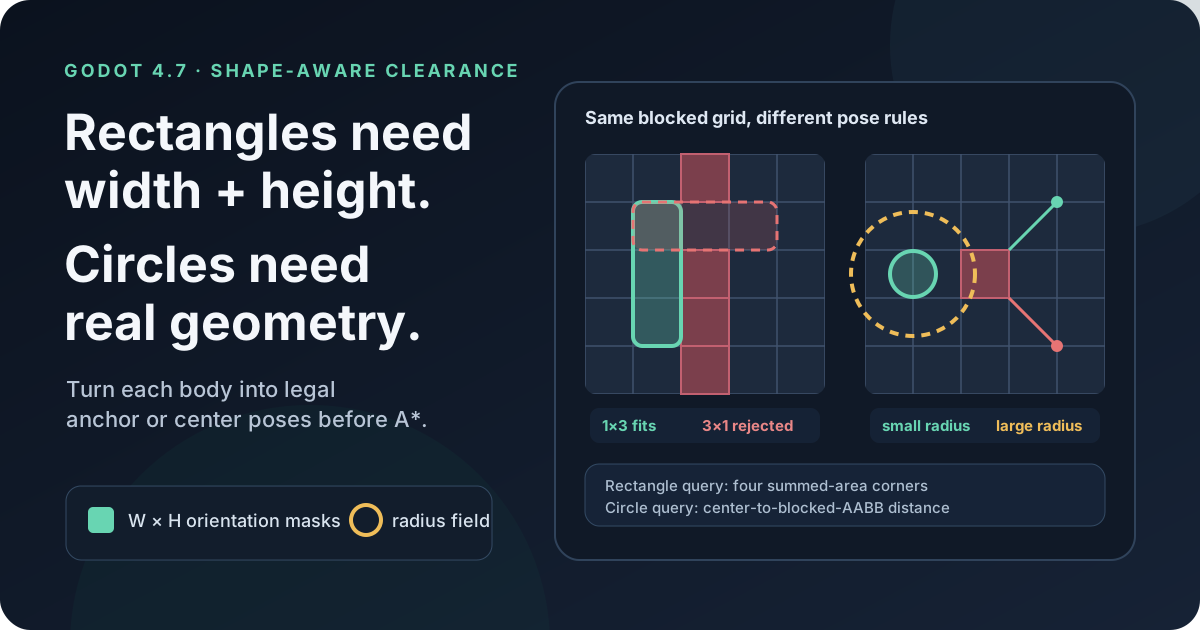
For an axis-aligned rectangular unit on a Godot grid, store its footprint as Vector2i(width, height) and test candidate anchors with either a summed-area blocked-cell table or a passability mask built for that footprint. For a circular unit, store a center and radius, then test candidate center cells against the actual blocked-cell geometry or a radius field derived from it.
The pathfinder can still search points. Those points represent legal poses: top-left anchors for rectangles and center cells for circles. Shape clearance decides which poses are available before A* expands them.
AStarGrid2D doesn't apply either body shape automatically. Its cell_size controls point placement, not agent dimensions. NavigationAgent2D.radius is an avoidance radius; Godot 4.7 documents that it doesn't affect normal pathfinding.
A project with two fixed shapes may be clearest with two masks or two AStarGrid2D instances. A shared structure is useful only when it makes the actual profile set or update pattern simpler.
This article proves whether a body can occupy a candidate pose. Moving between poses, rotating the body, and reserving runtime occupancy are separate contracts.
| Moving body | Clearance representation |
|---|---|
| Square N x N, grid-aligned | One maximal-square clearance value per anchor |
| Fixed axis-aligned rectangle W x H | Summed-area query or one passability mask per profile |
| Rectangle with 90-degree turns | Separate W x H and H x W orientation states and masks |
| Circle centered on grid cells | Blocked-AABB geometry field or one mask per radius |
| Free rotation or continuous free-space motion | Configuration-space, navmesh, or physics planning |
What square clearance can and can't encode
The square clearance guide stores the side length of the largest open square anchored at each cell. A value of 3 proves that 1x1, 2x2, and 3x3 square bodies fit there.
It doesn't answer whether 1x4 fits. Requiring square clearance 4 is safe but rejects narrow places where the rectangle fits without a 4x4 square. Requiring clearance 1 can let the other three cells overlap walls. A rectangle needs width and height, not one scalar size.
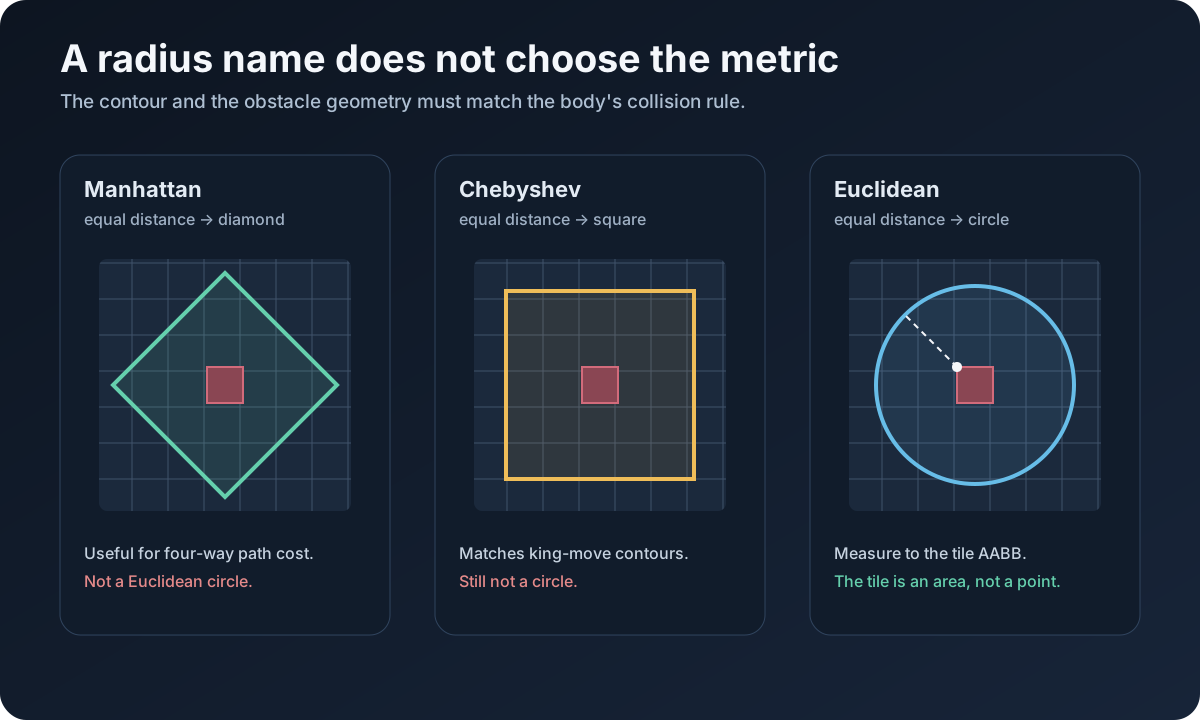
Circles need a different metric. Manhattan distance produces diamond contours; Chebyshev distance produces squares. A Euclidean collision rule needs Euclidean geometry.
Configuration-space planning supplies the common model: represent the entire body as a point, then mark every point-position that would collide as forbidden. The pathfinder searches the remaining point graph.
Rectangles need an anchor and orientation
This article uses the top-left occupied cell as the anchor. A 3x2 unit at (4, 5) occupies columns 4 through 6 and rows 5 through 6. That is the same convention used by the multi-tile movement guide.
Orientation belongs to the pose. A 1x3 north/south unit and a 3x1 east/west unit require different occupancy queries. If 90-degree turns are allowed, the search state is at least (cell, orientation).
Directly scanning all W * H occupied cells is a good baseline for small footprints. Precompute only when repeated queries justify it.
Query rectangles with a summed-area table
A summed-area table stores cumulative blocked-cell counts from the map origin. After it is built, the blocked count inside any axis-aligned rectangle comes from four lookups. The footprint fits when that count is zero.
This implementation assumes a zero-origin occupancy array. For a TileMapLayer region with a non-zero origin, subtract region.position before indexing.
A negative blocked_count() result means the query itself was invalid, not that the rectangle contains an empty count. rectangle_fits() therefore fails closed for invalid dimensions and out-of-bounds anchors.
The footprint test is a fixed four-corner query rather than an area scan. Updates are not free: one changed obstacle affects many prefix sums. The plain table is best for static maps or explicit rebuild phases.
For frequent dynamic blockers, keep static geometry in the table and test a small dynamic overlay separately, update dirty regions in a few prepared profile masks, or retain direct footprint checks for small rectangles. Use a more complex dynamic range-sum structure only after measurements justify it.
Rectangular rotation needs orientation states
For one obstacle/capability layer and 90-degree turns, prepare W x H and H x W masks. The pathfinder must include orientation in its state; otherwise a route can switch masks without validating the turn.
A rotation edge must check that the destination orientation fits at its declared pivot. A center-pivot turn may also change the top-left anchor. Continuous rotation near a wall needs swept-geometry validation because the rotating body can occupy more space than either endpoint rectangle.
The fit mask owns pose legality. The movement article owns pivots, touched transition cells, commit rules, and animation.
Circles need world units and blocked areas
Define the candidate position as the center of a grid cell, express radius in local units rather than a number of cells, treat each blocked tile as an axis-aligned rectangle, declare whether contact counts as collision, and decide whether the outside of the map is blocked.
The reference predicate below checks the circle against nearby blocked-cell AABBs. Contact is accepted within 0.000001 squared local units. The downloadable implementation precomputes the same minimum geometry distance into a reusable field.
This is a correctness reference, not the recommended inner loop for every A* expansion. The verifier compares the precomputed field with this direct geometry on 5,376 generated radius/cell cases, including non-square cells.
One geometry field can serve several radii
Store the minimum Euclidean distance from every candidate center to blocked geometry and the map boundary. A profile fits when that value satisfies its radius under the same contact-tolerance convention.
Several radii can share one field. The raster convention remains important: a standard Euclidean distance transform on a binary grid measures distance to obstacle samples, while a blocked tile occupies an area. Treating the tile center as the entire obstacle can let a circle clip an edge or corner.
Three defensible choices are exact point-to-blocked-AABB distance, a finer geometry raster with a documented approximation, or center-sample distance plus a conservative margin such as the tile half-diagonal. The last option deliberately rejects some valid space.
Don't describe a center-sample field as exact tile geometry unless the conversion has been proved.
Apply the shape predicate to pathfinding
After preprocessing, neighbour acceptance is small: a rectangle reads an orientation-specific mask, while a circle compares the stored squared distance plus the declared tolerance with its squared radius.
For a few fixed shapes, prepare one AStarGrid2D per rectangle orientation or circle radius and mark invalid points solid. For many profiles, use a custom search whose neighbour expansion calls the profile predicate. The Annotated A* guide shows that integration point; its own artifact intentionally remains square-only.
Direct checks may be easier to maintain for small, frequently changing footprints.
For continuous circular actors, navmesh baking is a different architecture. NavigationPolygon.agent_radius shrinks the baked walkable surface, and Godot's actor-type workflow uses separate navigation maps for different radii. Complex shapes aren't represented by that radius model. Use the grid-vs-navmesh guide for that system choice.
A shape-safe cell is not automatically a shape-safe edge
Rectangle or circle clearance proves that the body can occupy an endpoint pose. It doesn't prove the transition.
A rectangular diagonal may touch cells outside both endpoint footprints. A circle moving along a segment sweeps a capsule that can hit a corner. A rotating rectangle can occupy more space than its two endpoint orientations.
For discrete one-cell tactics, define a conservative transition rule and use it in both planning and execution. For continuous movement, use an appropriate geometry or physics sweep and account for its numerical contract. Runtime ownership remains separate; the reservation-table guide handles units competing for otherwise legal cells.
Choose the smallest sufficient representation
No representation wins every workload. Use the smallest one that matches the body shapes, obstacle updates, and movement rules the game actually ships.
| Approach | Build/update cost | Query cost | Best fit | Main limitation |
|---|---|---|---|---|
| Direct occupied-cell offsets | None | Footprint area | Small or changing shapes | Repeats work during search |
| Summed-area blocked table | Full static rebuild | Four-corner sum | Axis-aligned rectangles | Plain form updates globally; no circles or L-shapes |
| Profile passability mask | One build per profile/orientation | One lookup | Few shipped profiles | Build work and memory grow with profiles |
| Blocked-AABB geometry field | Field rebuild | One radius comparison | Several circle radii | Geometry and tolerance must be explicit |
| Configuration-space orientation search | Larger state graph | Pose and edge lookup | Rotating rectangles | More states and transition rules |
Common mistakes
Most failures come from mixing pose, metric, and transition contracts. Keep each one visible in code and tests.
- Using
AStarGrid2D.cell_sizeas agent size. It controls point placement. - Changing
NavigationAgent2D.radiusto alter wall paths. It affects avoidance, not normal pathfinding. - Approximating 2x5 with square clearance 2. Three rows may overlap walls.
- Using an inscribed circle for a rectangle. The rectangle's corners can clip; a circumscribed circle is safe for translation but conservative.
- Calling Manhattan distance a radius field. Its contour is a diamond.
- Measuring only to blocked tile centers. A blocked tile occupies an area.
- Ignoring the map boundary. The center may be inside while the body is not.
- Rotating without orientation in the search state. The route gains an unvalidated free turn.
- Checking only endpoint poses. Fit, transition safety, and runtime ownership remain different contracts.
What the verifier checks
The machine-readable correctness receipt reports twelve named checks on Godot 4.7 stable. They include 9,216 rectangle comparisons, 5,376 circle comparisons, 1,600 radius-monotonicity comparisons, 80 generated profile-path cases, non-square cell geometry, map boundaries, orientation masks, the declared contact tolerance, a diagonal endpoint counterexample, and scene smoke.
The source ZIP was extracted into a clean directory and passed the same parser and verifier again.
Measurement-gap: this is a correctness receipt, not a speed or memory benchmark. The circle field is checked against a direct blocked-AABB reference; it is not described as an independent geometry implementation.
PathForge V1 currently uses a maximal-square clearance map for square N x N profiles. The rectangle and circle code here is a standalone article artifact, not an undocumented PathForge launch feature.
| Artifact | Verified state |
|---|---|
| Source ZIP | 11,813 bytes · SHA-256 recorded in the receipt |
| Headless checks | 12 passed · 0 failed · Godot 4.7 stable |
| Package rerun | Final ZIP extracted; bundled parser and verifier passed |
| Evidence boundary | Static pose correctness · no runtime, throughput, memory, or general swept-motion claim |
Frequently asked questions
Does AStarGrid2D support rectangular or circular agents automatically?
No. AStarGrid2D searches grid points and exposes solids and weights, but no agent width, height, footprint, or radius. Prepare a shape-safe solid mask per profile or use a custom search with a rectangle or circle fit predicate.
Can a square clearance map handle a 2x3 unit?
Not exactly. Requiring square clearance 3 is safe but rejects valid 2x3 poses; requiring clearance 2 can accept invalid ones. Use a Vector2i(2, 3) footprint query or a profile-specific passability mask.
Can one distance field support several circular radii?
Yes, when profiles share the same obstacle and terrain capability and the field uses the same geometry and contact convention. Each radius becomes a threshold. A field measured only to tile centers needs a proved conversion or conservative margin before it is safe for blocked tile areas.
Should I approximate a rectangular vehicle with a circle?
Only when the approximation matches the game's movement rule. An inscribed circle is unsafe because the corners extend beyond it. A circumscribed circle is safe for translation but conservative and discards orientation behavior.
Does NavigationAgent2D.radius change the path around walls?
No. Godot 4.7 documents it as an avoidance radius that doesn't affect normal pathfinding. Navmesh pathfinding needs separately baked NavigationPolygon resources and navigation maps for different actor radii.
How do I handle a rectangle that rotates?
Put orientation in the path state. For 90-degree turns, prepare W x H and H x W masks and validate every rotation at its declared pivot. Free rotation needs configuration-space or swept-geometry handling.
Do I need a separate AStarGrid2D for every shape?
No. Separate grids are simple for a few fixed profiles. A custom fit predicate is better when many dimensions or radii share one occupancy map. Direct validation may be simplest for small, frequently changing footprints.