Founding Month: pay what you want (suggested $29.99) · then Standard $39 · Studio $149
Last updated 2026-09-10 · first public build target: Q4 2026
What is PathForge?
A Godot 4 navigation addon for production grid and tactical movement.
PathForge is a Godot 4 navigation addon by Vav Labs, with the first public build targeted for Q4 2026. It adds multi-size agent clearance, dynamic blockers, tactical movement, and editor diagnostics on top of Godot's built-in navigation. V1 targets Godot 4.5+. The public Playground and benchmark repository are available now.
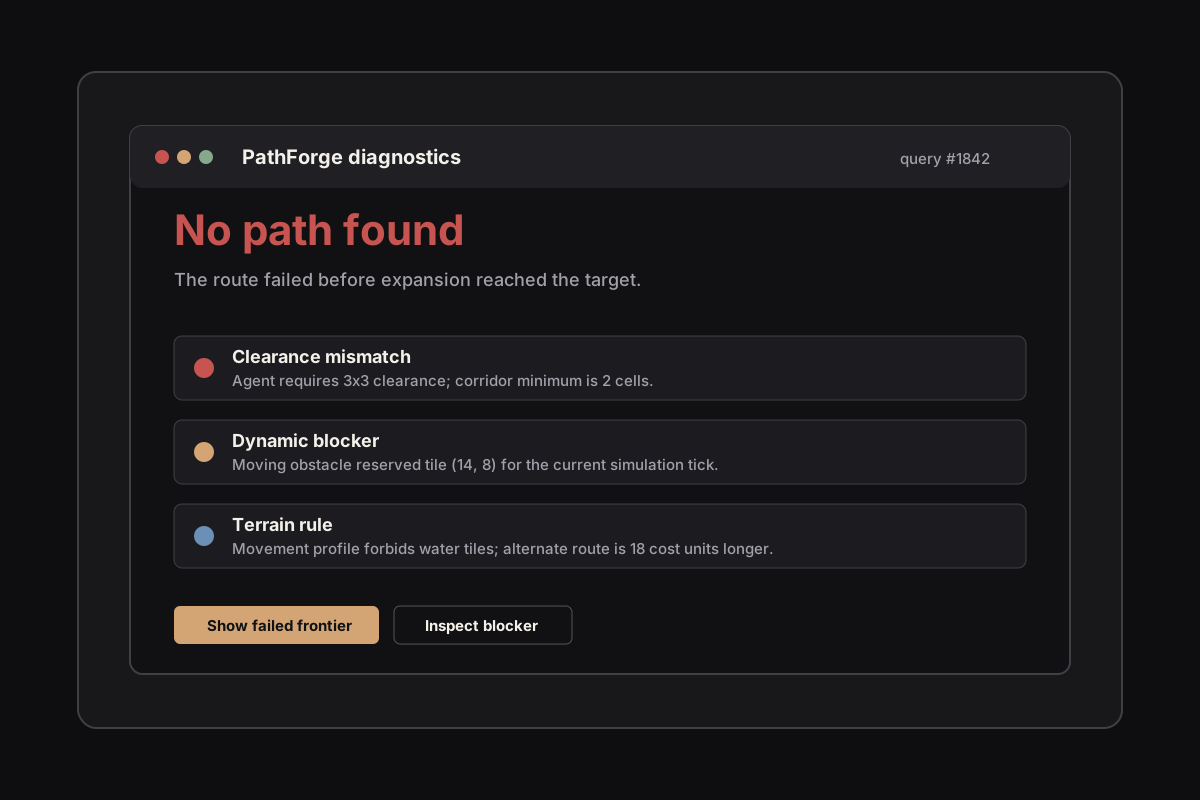
The hero of PathForge is the moment a failed route explains itself: click a stuck agent and read why — required clearance, the changed blocker, the unsynced map state. That "why no path?" panel now has a dedicated playground with editable route data, shareable cases, route JSON, validation artifacts, and benchmark data.
Reason-code panelDiagnostics workflow diagram — open the Playground for the interactive workbench and validation data.
Diagnostics playground
One route failure, three useful surfaces.
The public PathForge workbench is not a product tour. It is a small diagnostic surface for checking how named Godot navigation failures should look when the tool explains them instead of returning an empty array.
Godot navigation primitives are good at getting you started. Production is where the floorboards begin to creak.
Godot gives developers useful building blocks: AStarGrid2D, NavigationServer, navigation regions, and enough examples to move something around a map. That is a good beginning. It is also, for many tactical and agent-heavy games, only a beginning.
The awkward part arrives when the game stops asking for "a path" and starts asking for decisions: can a 3x3 unit stand here, how far can this enemy move after AP and terrain costs, what route does a crowd take when lanes change, why did this tower placement break the wave, and which tile is reachable without walking through a unit that is allegedly solid.
PathForge is being developed as a commercial Godot navigation layer for that stage of a project. It does not try to replace all navigation in all genres. It focuses on grid and tactical navigation first: the part of game AI where the map is discrete, the rules matter, and "why no path?" should have a better answer than silence.
Features
The production navigation layer PathForge is built around.
TileMap-driven grids, not duplicate map state
The first useful release is being developed around TileMap and TileMapLayer workflows: generated grids, terrain costs, blocked cells, dynamic blockers, and navigation data that does not have to be maintained in a second secret map.
Tactical movement beyond shortest path
Tactical RPGs, roguelikes, tower defense games, and simulations need movement ranges, AP costs, reachability maps, terrain penalties, and enemy threat overlays. A shortest path is useful. It is not a design document.
Explainable navigation failures
When a route fails, the answer should not be a shrug and an array of coordinates. The current build focuses on blocked-cell inspection, clearance visualization, movement-profile checks, and direct explanations for why no path exists.
Predictable performance path
The default Godot workflow should stay pleasant. The hot path still needs somewhere serious to go: batched queries, local graph updates, query budgets, cache-friendly data, and an optional Rust GDExtension core when profiling shows the need.
AStarGrid2D alternative
Built for the moment after the prototype works.
AStarGrid2D is a useful Godot API. It is not a bad tool because it has limits. Everything useful has limits. The dishonest tools merely hide them until your release candidate.
PathForge aims at the production gap: TileMap sync, multi-size unit movement, dynamic blocker updates, tactical cost layers, repeatable query performance, and debugging views that make the navigation system observable. The point is not to make pathfinding clever. The point is to make it boring enough to ship.
Production questions
Can designers see which cells are blocked, costly, or reserved?
Can different agent sizes share one map without duplicate handwork?
Can the game ask many path queries without surprise frame spikes?
Can a failed route explain itself in the editor?
Can a tower, door, unit, or hazard change the map without forcing a full-grid rebuild?
Workflow visuals
The editor should show the navigation system, not ask you to believe in it.
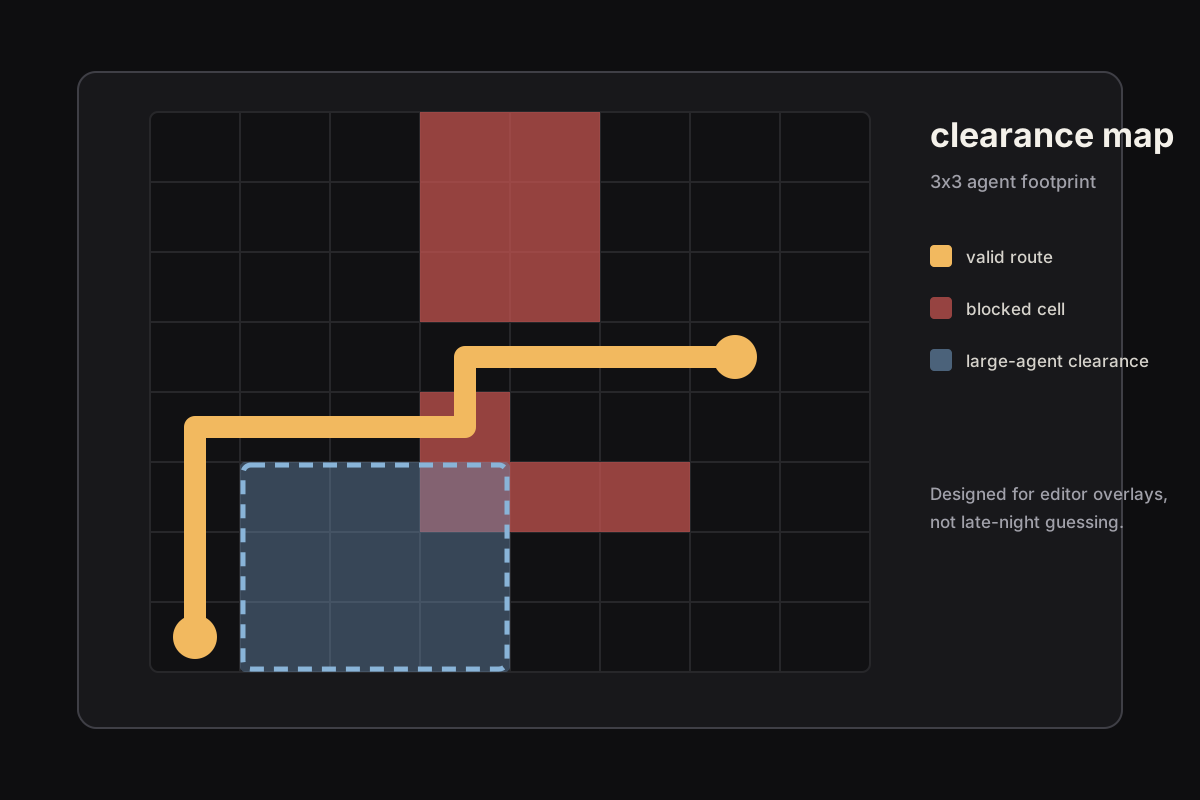
Clearance maps
Multi-size agents need more than single-cell A* assumptions. Clearance data makes large units visible to the editor before they enter invalid spaces.
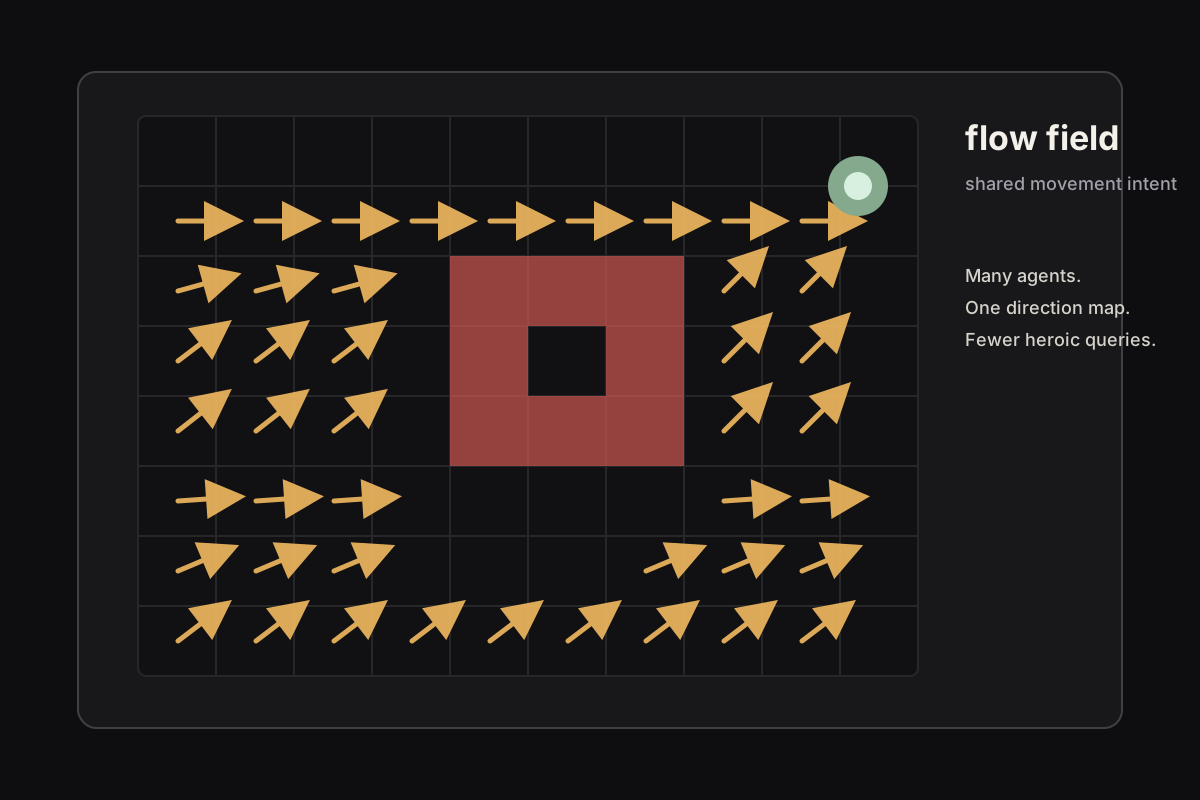
Flow field overlays
For RTS and crowd-like movement, repeated shortest-path queries get expensive quickly. Flow fields give groups a shared direction map instead.
Why no path diagnostics
A failed route should explain the failed assumption: blocked cell, insufficient clearance, terrain rule, or dynamic obstacle. Silence is not a debugging strategy.
Use cases
Godot tactical pathfinding for games where movement carries design weight.
Movement ranges, terrain costs, occupied tiles, large units, and readable overlays for players who need clear movement rules.
RTS
Many agents, repeated queries, flow fields, formations, and path pressure where a single-agent path is not enough evidence.
City-builder
Large maps, many agents, changing buildings, blocked-route diagnostics, and path cache reuse for long-running simulations.
Tower defense
Dynamic blocking, route validation, enemy lanes, and editor checks before one tower placement breaks the route.
Roguelike
Grid movement, changing maps, weighted terrain, reachability, enemy movement choices, and debugging tools for procedural levels.
Pricing
Launch tiers, stated early.
For the first 30 days PathForge launches as a Founding Month: pay what you want, suggested $29.99, minimum $0, with the complete V1. After that window, Standard is $39 fixed with a feature-update entitlement, and a Studio / Source / Benchmark tier at $149 adds multi-seat and source/reference access for teams.
30-day launch · suggested $29.99 · min $0
Founding Month
Pay what you want
The complete V1: grid toolkit + editor painters
Full diagnostics + multi-size clearance
Movement ranges, dynamic blockers, demo scenes
Fixed, after the founding window
Standard
$39
Everything in V1
Feature-update entitlement
Commercial game use
Studio · R&D · comparison
Studio / Source / Benchmark
$149
Multi-seat + source/reference access
Priority support
Commercial blessing + benchmark scenes
Current pricing reflects the V1 development scope, not a finalized commercial release.
Roadmap
The first release is being kept intentionally narrow.
V1 development is centered on the PathForge grid toolkit: TileMap-driven grid generation, reliable grid pathfinding, terrain costs, dynamic blockers, multi-size agents, clearance maps, editor overlays, and a query model that can grow into tactical systems without pretending every game is the same game.
Flow fields, influence maps, formation movement, deterministic helpers, and deeper RTS-scale behavior are queued as Studio and paid-module work. They belong in the product direction, but they should earn their place with real demos and profiler captures, not a feature table written before validation.
PathForge is a Godot 4 navigation addon by Vav Labs. It adds multi-size agent clearance, dynamic blockers, tactical movement, and editor diagnostics on top of Godot's built-in navigation. V1 targets Godot 4.5+. The public Playground and benchmark repository are available now.
Is PathForge available now?
Not publicly released yet. The first public build is targeted for Q4 2026. The current V1 work is focused on the problems that usually appear after a navigation prototype survives contact with a real game: multi-size agents, tactical movement constraints, dynamic blockers, repeated path queries, and debugging workflows that do not rely on guesswork. The early access list is open for developers and small studios who want launch updates and a chance to test the first release shape before it becomes fixed.
Does PathForge replace AStarGrid2D?
For production grid navigation, that is the intention. AStarGrid2D is useful for prototypes and small systems. PathForge is being developed for projects that need multi-size agents, diagnostics, tactical overlays, and repeated path queries without turning every edge case into custom glue code.
Is PathForge just another A* plugin?
No. A* is one useful algorithm inside the tool. PathForge is being built as a navigation workflow: TileMap-derived grids, terrain costs, dynamic blockers, movement ranges, clearance maps, tactical AI maps, diagnostics, and performance scheduling where the project needs it.
Does PathForge work with Godot 4.x?
The target is Godot 4.x, with the first production scope aimed at modern Godot 4 releases. The current development target is Godot 4.5+.
How is PathForge priced?
For the first 30 days, PathForge launches as a Founding Month: pay what you want, suggested $29.99, minimum $0, and you get the complete V1 either way. After that window, Standard is $39 fixed with a feature-update entitlement, and a Studio / Source / Benchmark tier at $149 adds multi-seat and source/reference access for teams. Paid purchases carry a 30-day money-back guarantee.
Can I use PathForge in commercial games?
The paid tiers are being prepared for commercial use. The final license text will be published before paid release.
Does PathForge support multi-size agents?
Yes, multi-size agent pathfinding is one of the main reasons PathForge exists. Clearance maps and editor visualization are being built as first-class features.
Will PathForge include volumetric 3D navigation?
Not in the first Grid-focused release. Volumetric navigation for flying, swimming, drone, and zero-gravity agents is a long-term expansion area, not a V1 promise. The first release is being kept narrow enough to ship and support properly.
Early access
Building a Godot game where movement is the game?
Join the early access list for launch notice, pricing updates, and the occasional practical question about what your pathfinding system is currently doing to your frame budget.