
Godot pathfinding / 2026-07-09 / 11 min read
Verified as of Godot 4.7 stable docs checked on 2026-07-09
Godot No-Path Reports: Turn an Empty Path Into a Diagnosis
Turn an empty Godot path into a useful no-path report: system, query, reason code, evidence, next check, and copyable output.
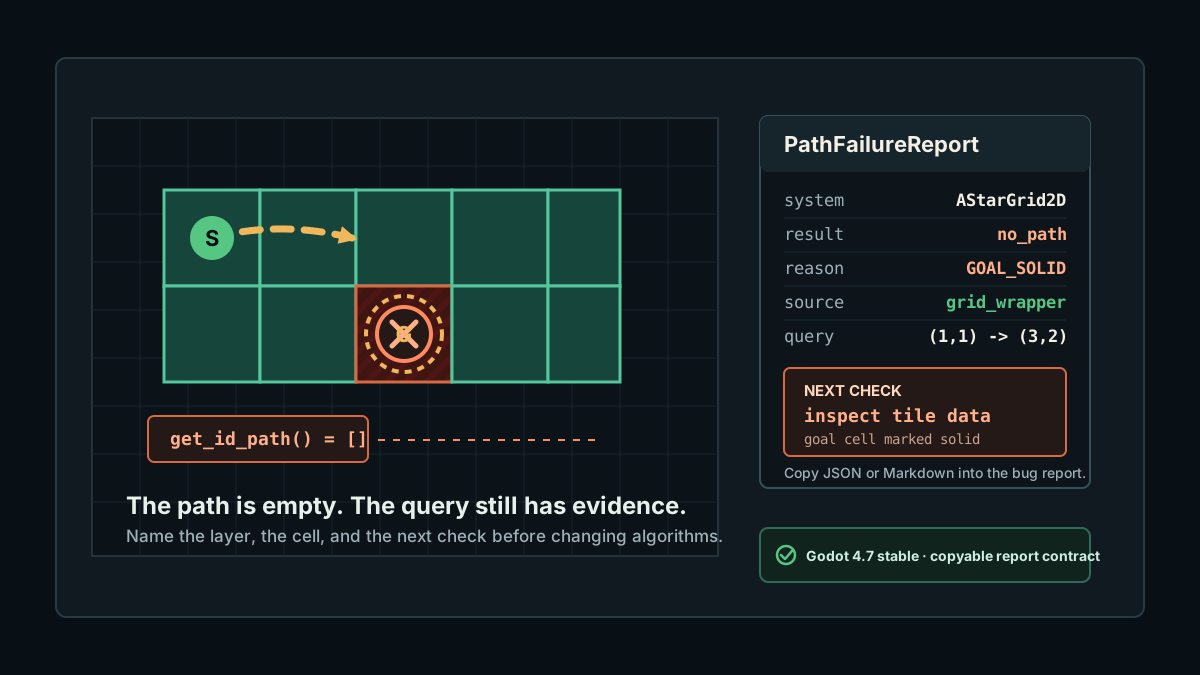
The direct answer
A useful no-path report should name the navigation system, record the exact query, give a stable reason code, and include enough evidence to tell the next developer what to check first.
When Godot gives you an empty path, start with the request you actually made. Was it an AStarGrid2D cell query, a direct NavigationServer2D.map_get_path() call, or a NavigationAgent2D target update that then depended on movement code?
Those boundaries matter. A solid AStarGrid2D start cell, a NavigationServer map with iteration id 0, a region on the wrong layer, and an agent whose parent body never moves can all look like a pathfinding failure from the outside.
Route by system
Jump to the layer that returned the empty path. This router is for the report shape in this article; the broader symptom checklist still lives in Why is my path failing in Godot?
- AStarGrid2D reports — cell queries, solids, dirty grid parameters, partial paths.
- NavigationServer2D reports — map sync, regions, navigation layers, direct path queries.
- NavigationAgent2D reports — current path evidence versus movement-code evidence.
Start with the query
When a log line isn't enough, include the query, the system that answered, and the evidence behind the answer.
For pathfinding, the minimum report looks like this:
The report contract
Keep the first contract small enough that you'll paste it into an issue. Eight fields are enough for the first pass.
The stable reason-code list here mirrors the existing PathForge PathFailureReport.Reason enum. If the article later needs new public reasons such as AGENT_MOVEMENT_CONTRACT or PATH_ENDED_SHORT, extend the shared helper first instead of inventing a parallel vocabulary in prose.
| Field | Why it exists |
|---|---|
| system | AStarGrid2D, NavigationServer2D, NavigationAgent2D, or your wrapper. |
| query | Start, goal, map or grid id, layers, movement profile, and partial-path setting. |
| result | path_found, partial_path, no_path, ready, not_ready, or not_pathfinding. |
| reason | A stable reason code a human can search for later. |
| evidence | The measured fact behind the reason. |
| next_check | The next practical inspection step. |
| source | The tool or script that produced the report. |
| godot_version | The engine version used by the proof run. |
Use the existing reason codes
Reason codes are useful only when the corpus reuses them. This article doesn't introduce START_OUT_OF_BOUNDS; the shared diagnostics helper already groups out-of-bounds start and solid start under ASTARGRID_START_SOLID, with evidence explaining which one happened.
PATH_ENDED_SHORT already exists in the navigation debug panel as a NavigationServer2D.map_get_path() verdict. That's a panel/query-outcome verdict today, not a shared PathFailureReport reason. If you turn it into a copyable report reason, update the helper first.
| Reason code | What it means | First check |
|---|---|---|
NONE | The report found a usable path or a ready preflight state. | Use the returned path, then inspect movement only if the actor still stalls. |
ASTARGRID_START_SOLID | The start cell is outside the grid region or marked solid in the shared taxonomy. | Inspect world-to-cell conversion, grid.region, TileMapLayer custom data, and dynamic blockers around the start. |
GOAL_INVALID | The target cell is outside the AStarGrid2D region. | Inspect target selection, world-to-cell conversion, and whether the grid region matches the authored map. |
GOAL_SOLID | The target cell is inside the grid but marked solid. | Inspect TileMapLayer custom data, blocker reservations, and any state that marks the goal unwalkable. |
GRID_PARAMETERS_DIRTY | Grid parameters changed and the grid needs AStarGrid2D.update() before querying. | Call grid.update() after region, cell size, offset, or shape changes, then rerun the same report. |
INSUFFICIENT_CLEARANCE | The route may be valid for a point but not for the moving agent footprint. | Inspect clearance data and compare required footprint against available corridor width. |
TERRAIN_FORBIDDEN | The target or route enters terrain that the movement profile forbids. | Compare TileSet custom data or terrain tags against the unit movement profile. |
DISCONNECTED_REGION | Start and goal are valid but no connected route reaches the requested target. | Run a connected-component overlay or inspect blockers between the components. |
UNSYNCED_NAVIGATION_MAP | The NavigationServer2D map has not synchronized yet. | Check NavigationServer2D.map_get_iteration_id(map) and defer the query when it is 0. |
REGION_BAKE_MISSING | The navigation map has no usable registered region for the query. | Inspect NavigationRegion2D nodes, enabled state, map assignment, and baked NavigationPolygon data. |
NAVIGATION_LAYER_MISMATCH | Regions exist, but none overlap the query layer bitmask. | Compare the query navigation_layers with each NavigationRegion2D layer bitmask. |
AVOIDANCE_NOT_PATH_BLOCKER | Runtime avoidance was blamed for a global path query result. | Use avoidance for local safe velocity; update grid/nav data when a blocker should change the path. |
A small report helper
Use one helper to keep every branch complete. Otherwise the first success path will have six fields, the second failure path will have four, and the copyable report will quietly stop being copyable.
The JSON and Markdown functions are deliberately boring. JSON is for tools and build logs. Markdown is for issue threads, pull request comments, and quick review by another developer.
AStarGrid2D reports
AStarGrid2D is the easiest place to produce a useful report because the query is grid-local. You usually know the start cell, goal cell, grid region, solids, movement mode, and weight rules before calling get_id_path() or get_point_path().
Do the cheap checks before search: update a dirty grid, reject an illegal start, and fail early when the goal is outside the region or solid.
Preflight before path outcome
The report_navigation_map() function above is a preflight report. It tells you whether the map is ready enough to ask; the path-query report still has to inspect the points returned by map_get_path().
For the real map_get_path() outcome, compare the final returned point against the requested goal. The navigation debug panel article already uses PATH_ENDED_SHORT for the verified case where map_get_path() returned points but stopped short of the destination.
If this article later ships that check as a copyable report, add PATH_ENDED_SHORT to the shared taxonomy first or link it explicitly as the #003 panel verdict.
Avoidance is outside the path query
Avoidance is the other common wrong turn. In Godot, avoidance can change a safe velocity around other moving bodies or avoidance obstacles. It doesn't rebake a navigation mesh or make a direct path query route around a new wall.
A good report says that directly. If the path query result is unchanged before and after enabling avoidance, the problem isn't a no-path result. The next check belongs in the game rule that should update grid cells, navigation regions, dynamic blockers, or reservations.
Print JSON and Markdown
The report should be copyable from the first version. Generate both formats from the same dictionary, not from two hand-maintained examples.
That way a headless smoke test can print JSON for machines and Markdown for the person reading the issue.
Test the report code
The report code needs tests too. Otherwise you'll trust the wrapper before it's earned it.
A tiny headless fixture is enough to start. Build a known grid, trigger one failure, print the report, and make the process exit nonzero when the reason is wrong.
- valid grid, valid route ->
path_found - valid grid, unreachable goal with
allow_partial_path=true->partial_path - start outside region or solid start ->
ASTARGRID_START_SOLID - invalid goal ->
GOAL_INVALID - solid goal ->
GOAL_SOLID - dirty grid ->
GRID_PARAMETERS_DIRTY - valid endpoints but no connection ->
DISCONNECTED_REGION - navigation map iteration 0 ->
UNSYNCED_NAVIGATION_MAP - navigation map with zero regions ->
REGION_BAKE_MISSING - navigation map with regions outside the query bitmask ->
NAVIGATION_LAYER_MISMATCH - agent path exists but the body doesn't move ->
path_foundwithreason=NONE, plus movement evidence - avoidance-only obstacle blamed for path blocking ->
AVOIDANCE_NOT_PATH_BLOCKER
What PathForge should add
For this layer, PathForge only needs to make the report explicit.
The existing workspace already has PathFailureReport, AStarGridDiagnostics, and NavigationServerDiagnostics. Before this article gets proof schema, the helper should grow to_dictionary(), JSON-ready output, and one or two fixtures that generate the examples in this page.
Until then, use the playground to match a reason code to a visual case in the Failure-Mode Museum. That keeps the report vocabulary connected to a visible failure instead of leaving the reason code as a label in prose.
Measurement-gap: this article doesn't publish a timing benchmark or runnable proof scene yet. Until the PathForge helper and fixtures exist, it should stay content-only: no VideoObject, no Dataset, and no SoftwareSourceCode schema for a proof artifact that doesn't exist yet.
Frequently asked questions
What should a useful Godot no-path report include?
It should include the system queried, exact query, result, stable reason code, evidence, next check, source script, and Godot version used by the proof run.
Should AStarGrid2D start out of bounds get its own reason code?
Not in this corpus yet. The shared PathFailureReport enum already groups out-of-bounds start and solid start under ASTARGRID_START_SOLID, with evidence explaining which condition happened.
Does NavigationServer2D map ready mean the path exists?
No. A ready map means the map has synchronized and has matching regions for the query layers. You still need to run the actual path query and inspect path points, endpoint distance, and result metadata.
Should NavigationAgent2D movement failures be no-path reports?
Only if the path query itself failed. If the agent has a current path but the parent body doesn't move, report the path as found and put movement evidence in the report.
Does NavigationObstacle2D make a path query route around a runtime blocker?
No. Runtime avoidance can affect safe velocity, but it doesn't rewrite global path queries by itself. Real path blockers should update the grid, navigation data, or dynamic blocker layer.